
The Four P’s of Marketing: A Practical Guide
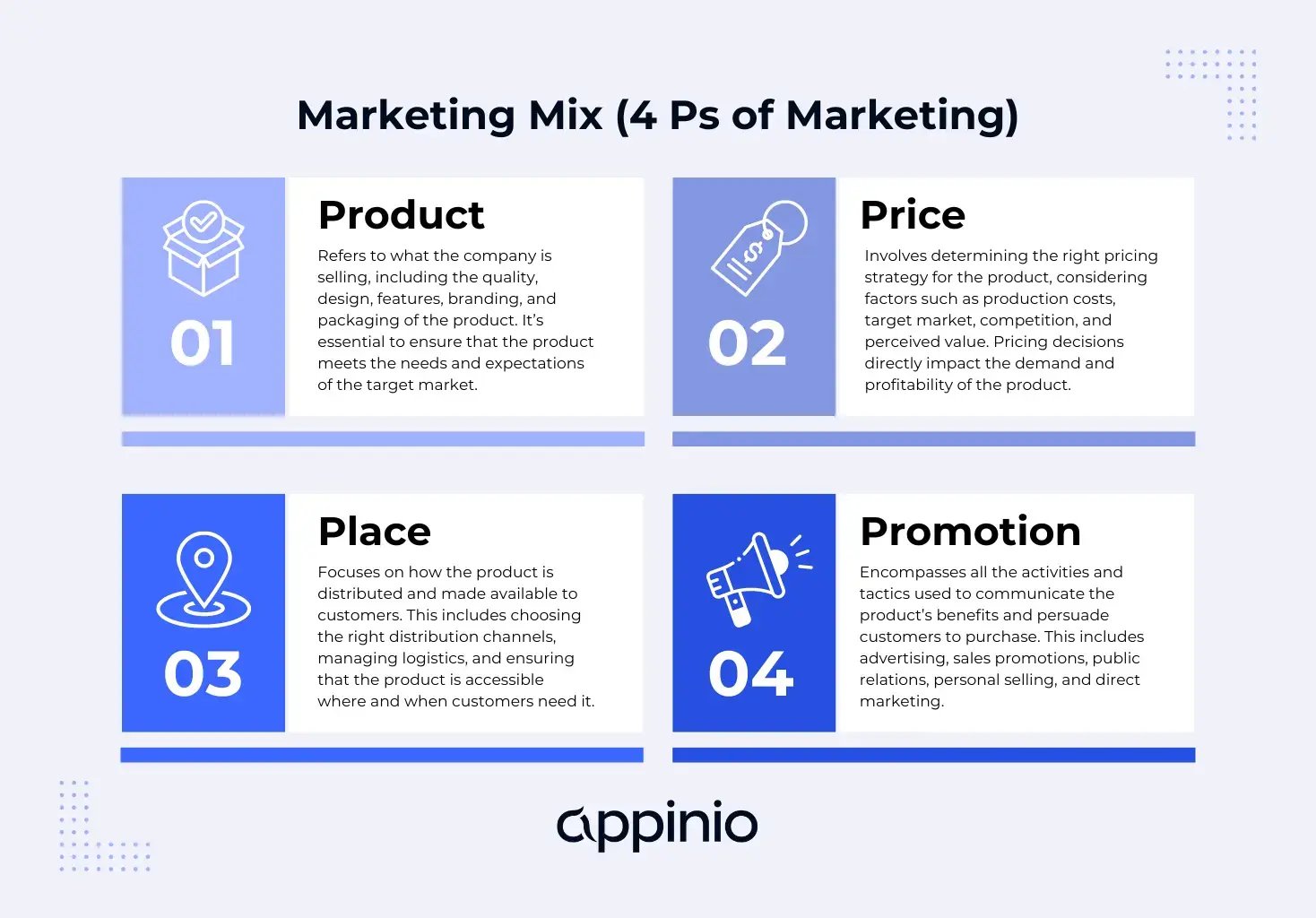
The four P’s of marketing—product, price, place, and promotion—are a framework for planning how to bring an offering to customers. Together, they help businesses define what they sell, how much it costs, where customers can find it, and how they will communicate its value.
These elements work best as a coordinated strategy. A premium product, for example, may need pricing, distribution, and advertising that reinforce its quality. If one element conflicts with the others, customers may find the offer confusing or unconvincing.
Product
A product is the good, service, or experience a business offers to meet a customer need. The term includes more than the item itself. It can also cover design, features, quality, packaging, customer support, warranties, and the overall experience of using it.
To make strong product decisions, businesses need to understand their customers and the problem the product is meant to solve. Useful questions include:
- Who is the product for?
- What need or problem does it address?
- What makes it different from alternatives?
- Which features matter most to customers?
- What support or services should accompany it?
For example, a company selling reusable water bottles might compete through durable materials, easy-to-clean designs, distinctive colors, or a strong environmental commitment. The product strategy should focus on the qualities customers value—not simply on adding more features.
Price
Price is what customers pay to receive a product or service. It affects revenue, profitability, and how people perceive an offer. A low price may appeal to budget-conscious buyers, while a higher price can signal premium quality—but only if the product and customer experience support that impression.
Pricing decisions can account for production and operating costs, customer demand, competitors’ prices, perceived value, and business goals. Common approaches include:
- Cost-based pricing: Setting a price based on costs plus a desired margin.
- Competitive pricing: Considering the prices of similar offers in the market.
- Value-based pricing: Setting a price according to the value customers believe they receive.
- Subscription pricing: Charging customers on a recurring schedule for continued access or service.
Price also includes details such as discounts, payment plans, shipping fees, and return policies. These can influence whether customers decide to buy, so they should be clear and consistent with the brand’s positioning.
Place
Place refers to how and where customers can access a product. This includes sales channels, distribution partners, delivery options, and the geographic areas a business serves. The goal is to make the offer available where target customers are likely to look for it.
Depending on the business, place may include a physical store, an ecommerce website, online marketplaces, retail partners, or a combination of channels. A business should consider customer preferences, convenience, inventory, shipping time, and the cost of serving each channel.
For instance, a local bakery might sell through its storefront, offer online ordering for pickup, and deliver through a third-party service. Each channel can reach customers in a different way, but the experience should feel consistent across them.
Promotion
Promotion is how a business communicates with potential and existing customers. It helps people learn about an offer, understand its benefits, and decide whether it meets their needs.
Promotional activities can include advertising, public relations, email campaigns, social media, content marketing, sales promotions, and direct outreach. The right mix depends on the audience, the product, the budget, and the goals of the campaign.
Effective promotion begins with a clear message. Businesses should explain who the offer is for, what benefit it provides, and what action customers can take next. Messages should be adapted to each channel while remaining consistent in tone and meaning.
How the Four P’s Work Together
The four P’s are most useful when considered as a group. Imagine a business launching a premium skincare product. It might develop a carefully formulated product, set a price that reflects its quality, sell through its own website and select retailers, and promote it with educational content and product demonstrations.
If the same product were priced like a low-cost option, sold through channels that do not fit its image, and promoted with unclear claims, the marketing mix would feel inconsistent. Alignment helps customers understand what the product offers and why it may be right for them.
Using the Four P’s in a Marketing Plan
Businesses can use the four P’s as a planning checklist:
- Define the customer: Identify the audience and learn about its needs, preferences, and buying habits.
- Shape the product: Decide what the offer includes and how it will provide value.
- Set the price: Choose a pricing approach that reflects costs, customer value, and business goals.
- Choose the place: Select the channels and distribution methods that make the offer accessible.
- Plan promotion: Choose messages and channels that reach the intended audience.
- Review and adjust: Monitor results and update the marketing mix as customer needs and market conditions change.
Conclusion
The four P’s of marketing provide a straightforward way to organize key business decisions. Product, price, place, and promotion each play a distinct role, but their greatest impact comes from working together. By understanding customers and keeping these elements aligned, businesses can create clearer, more relevant marketing strategies.
The 4 Ps of Marketing: FAQs and Related Marketing Frameworks
- What is the most important of the 4 Ps of marketing?
- What are 7Ps of marketing?
- What are the 4 Ps and 7Ps of marketing?
- What are the 4 Ps of marketing?
- What are the 4 C’s of marketing?
- What does the 4 Ps mean in marketing?
- What are the 4 Ps to 4 E’s of marketing?
- What are the 4 or 5 P’s of marketing?
What is the most important of the 4 Ps of marketing?
There isn’t one universally most important P because product, price, place, and promotion work together. However, product is often considered the foundation: if an offering doesn’t meet a real customer need or deliver value, effective pricing, distribution, and promotion are unlikely to make it successful for long. The right priority depends on the business, its customers, and its goals, so marketers should keep all four elements aligned.
What are 7Ps of marketing?
The 7 P’s of marketing expand the traditional four—product, price, place, and promotion—to include people, process, and physical evidence. People are the employees and others who shape the customer experience; process refers to the steps used to deliver a product or service; and physical evidence includes the visible cues that help customers assess a business, such as its website, storefront, packaging, or reviews. The expanded framework is especially useful for service-based businesses, where customer interactions and the way a service is delivered are central to the overall experience.
What are the 4 Ps and 7Ps of marketing?
The 4 Ps of marketing are Product, Price, Place, and Promotion: what a business offers, how much it costs, where customers can find it, and how it is promoted. The 7 Ps include these four elements plus People, Process, and Physical Evidence. These additional factors are especially useful for service businesses: People refers to the staff and others who shape the customer experience, Process covers how the service is delivered, and Physical Evidence includes tangible cues—such as a website, storefront, or branded materials—that help customers judge the service.
What are the 4 Ps of marketing?
The 4 Ps of marketing are product, price, place, and promotion. They describe the key decisions businesses make when bringing an offering to customers: what they sell, how much it costs, where customers can find it, and how they communicate its value. When these four elements work together, they help create a clear, consistent marketing strategy.
What are the 4 C’s of marketing?
The 4 C’s of marketing are a customer-focused framework: customer value, cost, convenience, and communication. They offer a way to view the traditional 4 P’s—product, price, place, and promotion—from the customer’s perspective. Instead of asking what product a business wants to sell, for example, it asks what value customers need; instead of considering price alone, it considers the full cost to the customer. This approach helps businesses create marketing strategies that are more responsive to customer needs and preferences.
What does the 4 Ps mean in marketing?
The 4 Ps of marketing are Product, Price, Place, and Promotion—the four key elements businesses use to plan how they offer and sell a product or service. Product is what the business provides; Price is what customers pay; Place is where and how customers can access it; and Promotion is how the business communicates its value. Together, these elements help create a consistent marketing strategy that meets customer needs and supports business goals.
What are the 4 Ps to 4 E’s of marketing?
The 4 Ps of marketing—Product, Price, Place, and Promotion—can be reframed as the 4 Es: Experience, Exchange, Everyplace, and Evangelism. Product becomes Experience, emphasizing the customer’s full experience rather than the item alone; Price becomes Exchange, focusing on the value customers give and receive; Place becomes Everyplace, reflecting the many online and offline channels where customers can connect with a brand; and Promotion becomes Evangelism, encouraging meaningful engagement that inspires customers to share and recommend the brand. This shift puts the customer relationship at the center of marketing decisions.
What are the 4 or 5 P’s of marketing?
The four P’s of marketing are product, price, place, and promotion: what a business offers, what it charges, where customers can find it, and how it communicates its value. Some frameworks add a fifth P, usually people, highlighting the employees and customer service that shape the customer experience. In service marketing, the model is often expanded to seven P’s by adding process and physical evidence.